Friday, May 1, 2020

Ordered Anarchy: Riding Scooters in Taiwan - 機車

by Charles DeBenedetto

(A normal day on the roads in Taiwan. Photo Credit: Fine Art America)

“I should probably get up before I am run over,” I thought to myself.

I was new, inexperienced with my iron horse. My scooter, which would be called a moped in the States. A 100cc engine, fifteen years old, and bought second-hand for probably too much money. It was not even close to the fanciest thing on the road, but I loved it. From the scraped gray plastic exterior, to the sticker that declared, “the scooter is all my life!” to the specks of black pavement covering one side of it, I cherished it for its ridiculousness.

But I was not prepared to ride it. Growing up with ATVs and snowmobiles, screaming down abandoned trails and across frozen lakes, I knew how to handle a machine, but I had zero experience with the locust swarm-like synchronized madness of scooters on Taiwanese city streets.

“But you had a license, right?”  Of course I did, but that did not prepare me for reality.

* * *

It is a hot, sweltering August day, and I am drenched in sweat before I even walk into the DMV. I take a number, waiting for a computer to be vacant so I can take the written test, and I spend the whole time chugging water, one paper cup at a time, from the lone water bubbler that is meant to serve the hundreds of people here. My number is called, I sit down, and choose the English test.

The first hurdle is understanding the English, because it is not perfectly translated from the Mandarin, but it is alright once you acclimate to it. Basically, you need to know kilometers, what the road signs mean, and a few basic Chinese characters. 停 is “stop,” 慢 is “slow” and 禁止機車 means “scooters prohibited.” I passed, barely, and I distinctly remember wishing to review the questions I got wrong, but not getting the opportunity.

I expected that my “road test” would actually be on the road, but instead, the DMV has a large open-air course, complete with a viewing section for onlookers to cheer you on. It looks more like I am going to play on the bumper cars than an actual road test. I wait in line for a long time, pushing my scooter a few inches every minute or so, until finally it is my turn.
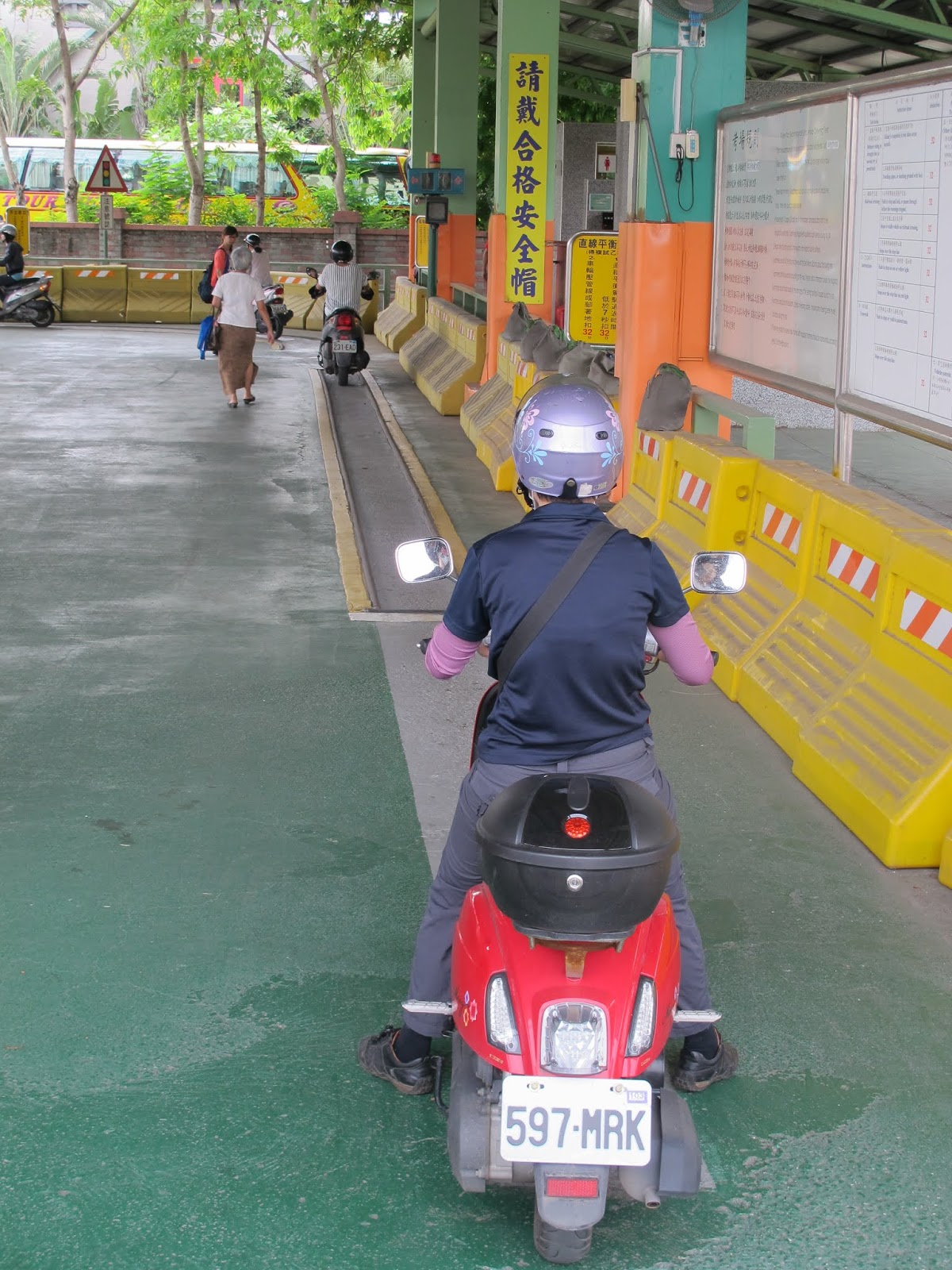
(The straightaway at the beginning is everyone’s worst nightmare. Photo Credit: Nomad Notions)

“Okay, you can go,” the DMV worker says.

BEEEEEEEP!!!!!

I pressed the horn, not the ignition…oops…

Luckily, they do not begin to grade until after you cross the starting line. I drive down a narrow path, stop at the red light, turn left, turn right, stay in the lines, wait for the imaginary train to pass, and drive out. The whole process must have took about a minute.

Yay, I’m done! I have a license in a foreign country, so that’s cool. It takes about an hour for the license to be prepared, and while I’m waiting I am required to watch a short film about all the ways I can possibly die while riding a scooter. Certainly not a feel good ending to the process, but I’m glad it’s required, because being on a scooter is no joke.

And then, I am on the road.

VRRM! Scooters go around me because I am too slow. A car is live-parked in the right-hand lane. I need to go into the left-hand lane to go around, but when? An endless stream of flying cars and bikes. Okay, I made it. What?! Did that old man just jaywalk without even looking? I stop at the red light, but other vehicles choose not to. Am I going to make it home? Did the Taiwanese government really just confirm that I am qualified to be on these roads?

I remained unscathed for about a month, until one day, coming home from work, I was stopped at a red light, with some stopped scooters ahead of me who were in the process of a two-step left turn. By now I was accustomed to hitting the throttle the moment the light turned green, so I went fast before noticing the scooter in front of me was not moving. I tried to brake and turned left to avoid him, and I went down, the full force of the fall going into my left knee. My water bottle rolled away out of my backpack’s side pocket.

“I should probably get up before I get run over,” I thought to myself.

Ignoring the pain in my knee and the scooters scooting around me, I get up, pitter over to the curb, and assess the situation. I seem to be okay, but I have adrenaline in my system. My bike has a few more scratches, but it already had plenty when I bought it. Collecting myself, I ride home to calm down.

* * *

Years later, I have yet to be in another accident, and my knee is fine. But I never forgot that day. Still, I am one of the slowest riders on the road, because I know that at any moment a car could come boldly flying out of a small side road (as often happens). I am one of the few who wear a full-face helmet, because, even though it is expensive and sweaty, it is the best life insurance policy you can get.

Riding a scooter in Taiwan is analogous to learning about the Universe. It is chaotic. It is madness. It is scary to be such a small player in a massive and dangerous place. But you have a part to play in it. You can feel the beat. You can find the rhythm. You can learn to dance in the ordered anarchy. But for God’s sake, wear a full-face helmet.

(I know it is cute. I know. Resist the temptation. If you get in an accident, that cute helmet will not help you, and then you will not look cute anymore. Photo Credit: aliexpress.com)

Saturday, April 25, 2020

Air Pollution: A Forgotten Issue - 空氣污染

by Charles DeBenedetto

(Air pollution in Taiwan today. The only place you ought to be exercising in is the east coast. Screenshot taken from: waqi.info)

I never really knew what air pollution was before coming to Asia, and that makes me very fortunate. As a child, whenever it was not raining it was fine to go outside, and I took that for granted. When something is overly abundant, we often do not cherish it, and so many days that I could have been playing outside, I spent inside with my television and video games. I told myself that it was the summer mosquitos that prevented me from going outside, but it was laziness.

I regret that now. Back then I had no way of knowing that one day I would live in another country. I would not have known that my future home, although excellent in many ways, would suffer from air pollution. This drastically changes the quality of life, despite Taiwan’s many modern conveniences, many of which are superior to the United States.

There are a lot of reasons for air pollution in Taiwan, and I will briefly summarize them. Most people might assume that air pollution comes from Mainland China, and that is certainly true when the wind is blowing from the northwest. But, most of Taiwan’s pollution is homemade. Partly it is our culture, since we regularly burn incense and “lucky money” during religious festivals. Partly it is our cramped society, with all of the scooters (mopeds) and cars on the road. But mostly, it is our fear of nuclear energy. Taiwan has nuclear power plants, but many are closed, as the public has expressed fear of a Fukushima-like nuclear meltdown.

And so, Taiwan burns a lot of coal. Infamously, the Long Jing coal-burning power plant in Taichung City is the largest emitter of carbon dioxide in the world. That is a world record that certainly does not belong in the Guinness Book.

(Long Jing Power Plant. Photo Credit: Taiwan News)

I wonder why the Taiwanese people are not constantly protesting outside of Long Jing. I have been in Taiwan for almost five years, and the air has been a problem since I arrived here, but friends I have talked to have said that the air quality has become continuously worse over the past decade. Unfortunately, part of the reason it was so easy to get people to wear masks during this covid-19 pandemic is because people already wear masks regularly to combat air pollution.

But wearing a mask does not fix the problem. It should be seen as a temporary solution to a problem that has not been fully addressed. And we think we can solve the problem by planting trees, as the Taichung City mayor has initiated a project called the “Mayor’s Trees,” but that is just distracting us from the root cause (pun intended). Others will assert that they are doing their part by riding an electric scooter, but, when the electricity comes from the coal-burning plant, how much good are you actually doing?

The Taiwanese government has made more windmills and solar panels, and that is great, but what we really need is nuclear energy. The reality for most Taiwanese people is that every day we check the weather forecast, not for rain or sunshine, but solely to check the air quality. Every day we check, hoping for the air-quality index to be green, so we can go for a walk, or a run, or a bicycle ride, and not have to wonder about the simultaneous benefits to our muscles and hurt to our lungs. But most days, we are disappointed.

I live in the countryside, a good distance from the city. Most days, when I ride my scooter home, the sky is a continuous white blanket, no blue sky between clouds, which is a good indicator that the air is polluted. I wear a mask every day when I ride, regardless of the air quality index, because of the exhaust of so many scooters and cars around me. There is no backdrop beyond the road to look at, because the air pollution conceals it.

But occasionally, when the coal-burning plant is not running at full capacity, I can see the tall, green mountains that are always there, but so seldom seen.

I pull over to the side of the road, stare, and forget to take a picture.

I feel like a tourist in my own neighborhood.

Perhaps if I saw them every day, I would take them for granted, too, like I did the beautiful natural world of my home in rural America. But when those mountains finally do come out, I’ll stare at them until the last rays of the Sun fall, and I’ll wonder when the next time I’ll see green mountains under blue skies again will be…

(If only we could always see these mountains. Photo Credit: https://www.erv-nsa.gov.tw/en)

Friday, April 17, 2020

Shi Ti Ping: The Small Space Between Gods - 石梯坪

by Charles DeBenedetto

 
(A view of the mountains and ocean from Shi Ti Ping. Photo Credit: K.H.)

Taiwan is an island. That sounds obvious, but it is also very easy to forget. The island is large enough that the average Taiwanese person probably does not often see the ocean, and yet the ocean plays a large role in the Taiwanese story. The first people to come to Taiwan arrived here about 5,000 years ago, somehow traversing the rough waters of the Taiwan Strait on what must have been extremely fragile boats. Then, roughly 400 years ago, Han Chinese peoples started to cross over from Fujian and Guangdong provinces. The most important goddess in Taiwan, Mazu, is the goddess of the sea and fishermen, and the ocean still is the provider of life for many people here. 

But in the picture above, it is clear that Taiwan is not your average tropical island, with flat sandy beaches stretching out into the distance. Instead, looming green mountains sit right on the water’s edge, a physical reminder of the island’s origin story of the collisions of numerous tectonic plates. Looking at this view, I see that the Taiwanese people carved their lives out of the extremely small space between gods. The mountain god takes the entire central spine of the island, the ocean god surrounds it, and then there is the tiny patch of flatland leftover. That is where Taiwanese society happened.

(The Pacific Ocean from Shi Ti Ping. Photo Credit: K.H.)

These pictures are from Shi Ti Ping, a scenic spot on the coastline of Hualian County, in eastern Taiwan. The road to get here is treacherous, and new. While indigenous peoples have been here a long time, only recently have roads been built here. First, the Japanese developed railroads through the mountains, and later Han Chinese blasted tunnels to make roads. The drive here is on a sliver of road that looks over a precipice, with waves crashing below. Road signs alert you to the danger of falling rocks, and tunnels that last for over ten kilometers give you a clue as to the enormity of the mountain you are driving through. The lush flora on the mountains looks like it belongs in a Jurassic Park movie, and I feel a calming feeling at the thought that much of this landscape still has been untouched by humans.

At Shi Ti Ping, there is nothing to do really, and that is why I like it so much. There is nothing to do but think. So I look at the waves crashing, and I think, “No wonder the Greek and Roman gods of the ocean were angry, muscular men with weapons in their hands.” I think, “No wonder Mazu, who is said to be a very graceful and beautiful woman, is who the Taiwanese pray for to calm the seas and protect fishermen.” I look at coconut trees growing next to rice paddies, and admire the ability of rice to adapt to so many different environments, growing both in tropical Taiwan and in temperate Japan. And I look out at the Pacific, which takes up a full quarter of our Earth, and I think about how on the other side of it, from Canada to California, all the way to South America, society is shut down and panic is widespread, while here, life is normal, and the Pacific lives up to its name of being able to pacify.

(A view from Shi Ti Ping. Photo Credit: K.H.)

Despite the lack of people, there is still a cacophony of noise. The ocean waves are incessant, the wind passes by, and the birds never end their songs. It feels as though people here have been able to live more in harmony with nature than those of us on the west coast have. I understand why people here are hesitant to allow the government to build a highway down the east coast, because, even though it would surely result in economic gains, the inevitable surge in tourists would hurt the ecology here.

My home in America is rural, with mountains, rivers, forests, ocean, and clean air every day. Having come from such a background, it is difficult for me to adapt to polluted air and city life, despite how long I have been here. In a search for clean air, there are very few travel destinations left for me, except for high mountains and the east coast. And so, going to Shi Ti Ping felt like a homecoming for me, and, although the economic opportunities for foreigners on the east coast are few, I will do my best to eventually relocate there if possible.